
Dharam Shiksha - Class 27
- Pooja Jain
- Feb 9
- 6 min read
Updated: Feb 10
Jai Jinendra everyone!
A big thank you to all the children who attended the last Dharam Shiksha class despite the change in venue. Your presence and support truly mean a lot to our team.
In this class, we formed groups based on learning levels.
Children who were not familiar with the "Arihanto Paath" were taught the paath, while the others revised the "Ichchakren Paath."
Next, we took up our topic for the day - Mithyatva.
What is Mithyatva?
Simply put, Mithyatva means “wrong understanding.”
It is just like wearing dirty or broken glasses. When your glasses aren't clear, your vision gets blurred and you are unable to see things clearly - even when they are right in front of you!
So basically, Mithyatva acts like broken/dirty glasses for our soul. It does not let our soul see the "Truth."

Mithyatva can be of 5 types:
1️⃣ “Only what I believe is right!”
This means being stubborn about your own beliefs. It means thinking that your thoughts are the best - you don't need to listen to anyone else.
Why is this approach wrong?
When we are stubborn about our belief system, we don't like listening to anything that does not align with our thought process. When we don’t listen, we cannot learn.
We need to understand that only what our Arihants told us is 100% correct as they have Kewal Gyan which is the ultimate truth.
2️⃣ “Everything is right, nothing is wrong!”
In this type of Mithyatva, a person believes all religions are the same. There is no difference between them at all. So basically, you believe that sacrificing animals in the name of "bali" is also dharma, and practicing ahimsa is also dharma.
Why is this approach wrong?
How can a belief system that treats terrible practices like "bali" at par with our pure and non-violent religion be right?
3️⃣ “I won’t change my thinking even if I’m wrong!”
In this type of Mithyatva, a person refuses to change themselves even when they realize that they might be wrong.
For instance, you read Jain scriptures and realize that eating after sunset is not a good thing, but you still eat late dinners thinking, "My grandparents eat at night too, so it's okay."
Why is this approach wrong?
A person with this kind of Mithyatva refuses to do the right thing because of their ego. Now ego blocks learning. It does not let us understand the "truth" or "correct knowledge."
4️⃣ “Maybe Jain dharma is right… maybe not…”
This is a state of confusion. A person in this type of Mithyatva wonders: “Is karma real? Does ahimsa really give punya? I’m not sure.”
He keeps doubting everything and never practices anything that is written in our scriptures.
Why is this approach wrong?
Dharma begins with faith. When you keep doubting everything, your spiritual progress stops.
5️⃣ “Doing wrong without knowing or caring”
Sometimes, people do wrong things without knowing that they are wrong. For instance, lots of children waste buckets of water during Holi without knowing wasting water is wrong.
And then there are are people who KNOW wasting water is wrong and yet do it anyway without caring.
Both these things fall under Mithyatva.
Why is this approach wrong?
Our dharma teaches "yatna" or mindfulness in day-to-day activities. Doing things with a careless attitude is a big mistake.
To make the kids understand the concept of Mithyatva better, we narrated an interesting story...
STORY TIME - From Doubt to Dharma: The Journey of Ashadhbudhi Ji
Once upon a time, in the city of Ujjain, there lived a great Jain acharya named Ashadhbudhi Ji. He had a large family of disciples who lived under his guidance and followed sanyam.
The Plague in Ujjain
One day, a terrible plague spread across Ujjain. Many people fell sick, including Ashadhbudhi Ji’s disciples. Whenever a sadhu from his group caught the plague, Ashadhbudhi Ji would give them Santhara. Each sadhu passed away peacefully, hoping to be reborn in Dev Gati.
A Doubt Enters the Acharya’s Mind
After many such deaths, a strange thought entered Ashadhbudhi Ji’s mind:
“I have given Santhara to so many sadhus, but not even one has come back to tell me how Dev Lok is.”

This thought kept returning again and again. Now, whenever he gave Santhara to a sadhu, he requested them:
“When you are reborn as a Dev, please come back and meet me once.”
But no one ever returned.
The Last Young Sadhu
Soon, only one young sadhu was left alive. While giving him Santhara, Ashadhbudhi Ji said:
"You are my only hope. When you go to Dev Lok, please come back and tell me whether Dev Lok truly exists or not. I am beginning to question everything — Dev Lok, Narak Lok, Siddhshila, and even Arihant Prabhu.”
The young sadhu was shocked.
“Gurudev! You are an Acharya. How can you doubt what Arihant Bhagwans have taught us?”
Ashadhbudhi Ji replied sadly:
“I cannot help it. These doubts have entered my mind, and I cannot remove them. That is why you are my only hope.”
The young sadhu accepted Santhara and passed away.
Loss of Faith
Days passed, but the sadhu did not return. Ashadhbudhi Ji now firmly believed:
“There is no Dev Lok or Narak Lok. I wasted my life practicing sanyam and studying false scriptures.”
He decided to leave monkhood and return to worldly life.
The Dev Remembers His Promise
At that very moment, the throne of the young sadhu, now reborn as a Dev, began to shake. He remembered his promise to his guru.
But he also thought:
“How weak was my guru’s faith, that he abandoned everything so easily?”
To test whether any compassion remained in Ashadhbudhi Ji, the Dev decided to use maya.
The Six Beautiful Children
Using his divine powers, the Dev created six beautiful children, richly dressed and covered with ornaments.
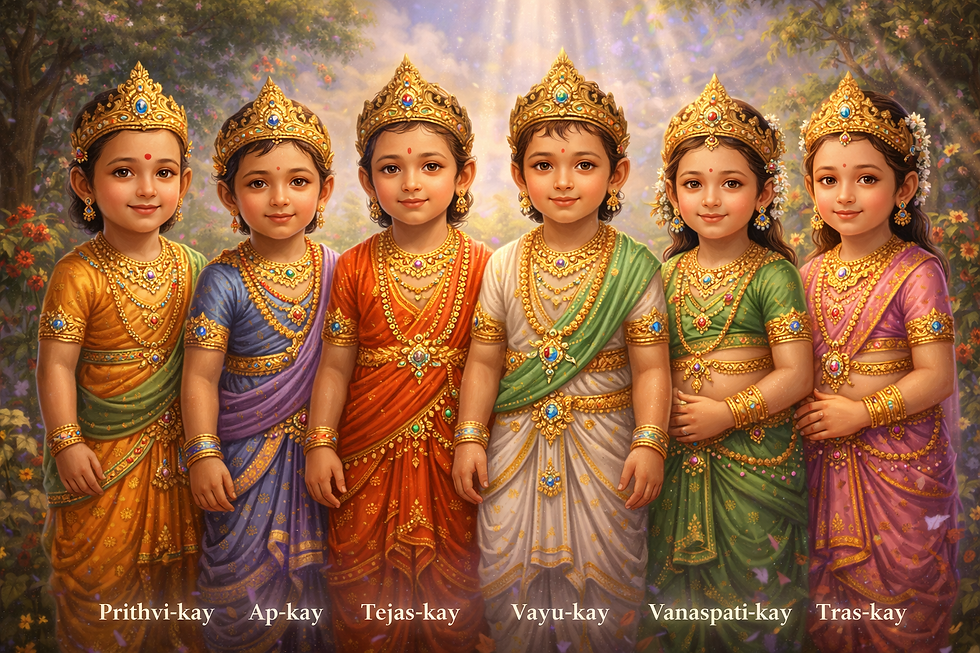
He sent them to Ashadhbudhi Ji.
Ashadhbudhi Ji was impressed and asked the first child:
“What is your name?”
The child replied:
"Prithvi-kay..."
Hearing this, Ashadhbudhi Ji became furious. The word reminded him of the scriptures he now hated. In anger, he killed the child and took his jewellery.
One by one, the same happened with the other children:
Ap-kay
Tejas-kay
Vayu-kay
Vanaspati-kay
Tras-kay
Ashadhbudhi Ji killed all six and collected their ornaments.
The Grand Natak
Next, Ashadhbudhi Ji reached a place where the Dev had created a magnificent natak (divine drama) using maya.
Ashadhbudhi Ji was overjoyed.
“The day I gave up sanyam, I gained jewellery and now I get to see such a grand show!”

The natak continued for six months, but due to maya, Ashadhbudhi Ji felt it lasted only 48 minutes! The Dev also removed his hunger and thirst, so he felt no discomfort.
The Truth Comes Out
When the natak ended, people gathered around Ashadhbudhi Ji, still respecting him as their Acharya. They invited him to their homes for gochari.
As Ashadhbudhi Ji tried to refuse, the jewellery hidden in his clothes fell onto the ground.
The crowd was shocked.
One person cried:
“That necklace belongs to my son Prithvi-kay! He has been missing for months!”
Another said:
“That bracelet belongs to my son Tejas-kay!”
Slowly, people realized the truth — the Acharya had killed their six sons and taken their jewellery!
They began cursing him and speaking bad words about him.
Deep Repentance
Ashadhbudhi Ji was filled with deep regret and shame. Closing his eyes, he prayed:
“Oh Lord, let the earth open and swallow me. I cannot bear this disgrace.”
Just then, he heard the words:
“Nissa-hi, Nissa-hi.”
He opened his eyes and saw his disciple in Dev form.
The Dev Reveals the Truth
With tears in his eyes, Ashadhbudhi Ji said:
“Son, you came too late. I fell into Mithyatva and committed terrible sins.”
He narrated everything that had happened.
The Dev smiled gently and asked:
“Gurudev, how long do you think the natak lasted?”
“48 minutes,” replied Ashadhbudhi Ji.
The Dev said:
“No. It lasted six months. This was all my maya. I did this to show you how fragile your faith had become. But not everything is lost. You can still return to sanyam.”
Final Decision
Ashadhbudhi Ji replied humbly:
“Even if it was your maya, I committed sins through my mind — violence, theft, and cruelty. I am no longer worthy to be a sadhu.”
The Dev advised him to take Prayashchit and accept sanyam again.
Return to True Religion
Ashadhbudhi Ji sincerely performed prayashchit for falling into Mithyatva, purified his soul, and once again accepted the true religion taught by our Arihant Bhagwans.
SUMMING UP...
We were happy to see many kids understood the concept of Mithyatva pretty nicely - even though it is a complex topic for sure! We also played a little game to make the learning more engaging and meaningful.
Finally, we would request all the kids to practice the Arihanto and Ichhakaren paaths as much as possible. And also, don't forget to share the above listed story with your family and discuss the concept of Mithyatva with them.


Comments